
What is RIGOROUS?
RIGOROUS is a methodological framework for designing, conducting, and reporting quantitative research using routinely collected health data. It guides researchers through an iterative eight-step process, with each step represented by a letter of the word RIGOROUS.
Unlike reporting guidelines, which are applied once a study is complete, RIGOROUS is intended to inform decisions while they are being made, to improve the quality of the research produced, not simply how it is reported.

Scope
RIGOROUS has been designed to support quantitative research that uses data generated through routine care and administration rather than for research purposes. This includes primary and secondary care records, prescribing and dispensing data, claims and administrative data, disease registries, and linked resources combining these with cohort or biobank data.
4 Research Tasks
RIGOROUS is explicitly task-based, requiring researchers to first identify the type of question they are asking before proceeding. This is because the task informs everything that follows, including how to formulate a clear research question, the types of biases that might apply, the relevant methods, and the appropriate language for reporting. RIGOROUS covers four tasks: description, signal discovery, prediction, and causal effect estimation, each with its own version of the eight steps.
-
Description
Estimate the occurrence or distribution of a health state, event, exposure, or practice in a defined population.
-

Signal Discovery
Scan many exposures, features, drugs, variants, or outcomes to identify candidate signals for further study.
-

Prediction
Predict current or future outcomes under observed or expected care conditions.
-
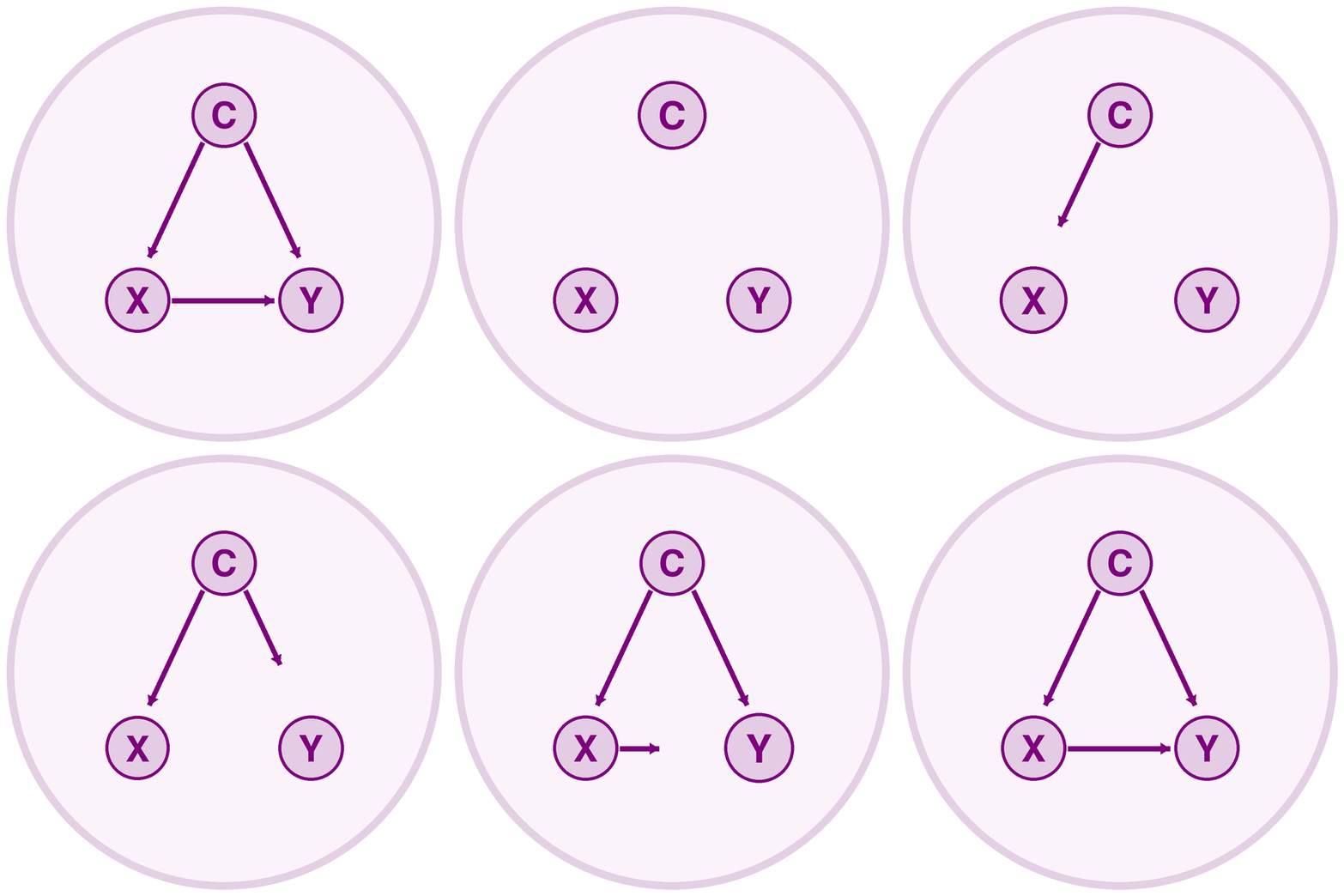
Causal Effect Estimation
Estimate the causal effect of an exposure, treatment, intervention, or policy on an outcome.
The 8 Steps
RIGOROUS is an eight-step framework designed to help researchers improve the quality, transparency, and interpretability of studies using health data.
R - Recognize the research task
I - Identify estimand(s) and context
G - Gauge data fitness
O - Outline sources of error and bias
R - Run appropriate analyses
O - Outline and assess assumptions
U - Use appropriate language
S - Satisfy reporting and transparency standards
Relationship with Other Guidance
RIGOROUS is distinctive in providing an end-to-end framework for use during the design, conduct, and reporting stages of quantitative health research. It is explicitly task-based and estimand-first, to ensure that researchers fully consider the issues that are relevant to their research question.
RIGOROUS has been designed to complement, not replace, existing guidance and resources. It differs from reporting guidelines such as RECORD and TRIPOD+AI by addressing design and conduct considerations rather than reporting alone. It differs from data quality frameworks by tying data fitness assessment to a specific task and estimand rather than in general terms. And it differs from task-specific methodological frameworks such as target trial emulation, the causal roadmap, and the predictimand framework by integrating insights and conventions from across the broader research space. Where alternative resources provide deeper guidance on a particular step, RIGOROUS explicitly directs users towards them.
Who is RIGOROUS for?
Investigators, for designing, conducting, or reporting studies using routinely collected health data, in academia, industry, government, and third-sector settings.
Regulators, HTA bodies, and other evidence users, for assessing whether a study was designed to answer the question it addresses.
Editors and peer reviewers, for evaluating whether a study's aims, methods, results, and conclusions are aligned and appropriate.
Educators, for teaching structured study design and connecting decisions and principles that are often taught in isolation.
Trainees, for planning and reporting research using routinely collected health data.
How to Use It
RIGOROUS is designed to be used throughout the research pipeline but is primarily intended for use during the study design and manuscript drafting stages. Working through the eight steps while designing a study protocol is intended to help researchers ensure that key decisions, around the estimand, dataset, and analysis approach, are considered and refined up front. During manuscript preparation, the framework is intended to enable researchers to demonstrate that methodological standards have been met, with steps U7 and S8 providing explicit guidance on language and reporting expectations.
An iterative framework
Although the eight RIGOROUS steps are presented as a sequence, the framework is intended to be used iteratively. All steps should therefore be considered at all stages of the research process. This is because engagement with later steps may reveal that earlier changes are necessary. For example, if the data are not fit for purpose for a particular estimand (G3) then the estimand may need refining (I2). Similarly, if certain assumptions checks fail (O6), then the analytical approach (R5) may need refining.
A choice of formats
The framework materials are available in two formats: guidance tables and questionnaires. The guidance tables serve as ongoing resources to consult throughout the research process, particularly during study design and analysis planning. The questionnaires allow investigators to document their adherence to the framework during manuscript preparation. They are available as downloadable PDFs for each task and as an integrated online tool, which allows users to save, return, and refine their answers throughout the project.